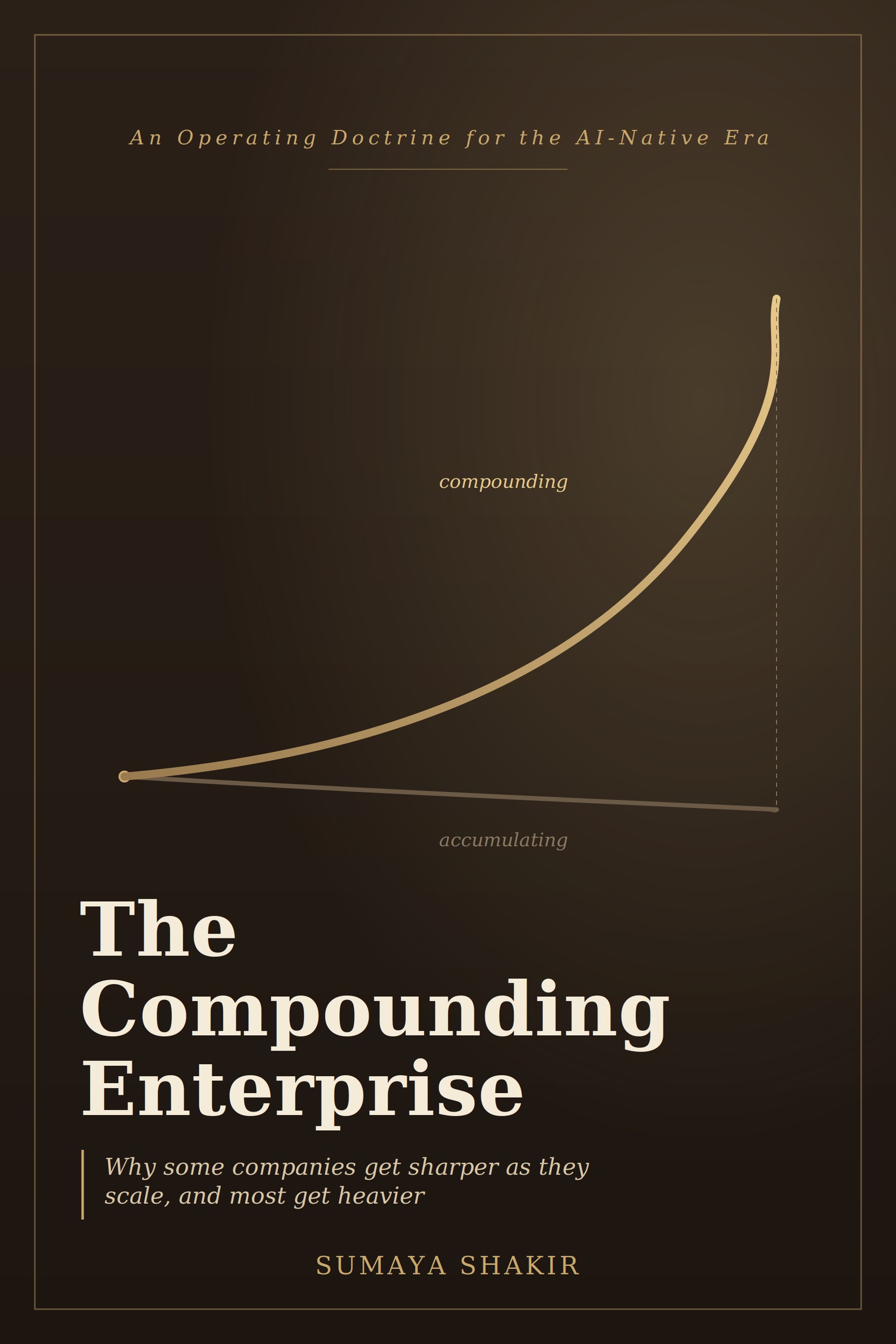
An Operating Doctrine for the AI Native Era
The Compounding Enterprise
Why some companies get sharper as they scale, and most get heavier.
By Sumaya Shakir · ScaleOrbit
Ebook. Available now.
Most enterprises do not fail. They accumulate.
Two companies begin in the same place. One grows sharper as it scales: every system strengthens the next, every capability compounds, and complexity is absorbed rather than multiplied. The other grows heavier. Workarounds become operating models. Fragmented systems harden into drag. Headcount rises to compensate for architecture that no longer scales.
The gap between them is not talent. It is not effort. It is not budget. It is architecture.
The Compounding Enterprise argues that technology is no longer a support function but the structural system through which modern organizations execute, scale, and survive. Artificial intelligence does not fix broken enterprises. It amplifies them. In coherent organizations, AI expands leverage, velocity, and margin. In fragmented ones, it accelerates confusion, operational strain, and economic decay.
This is not a book about emerging technology. It is a book about structural advantage.
“Scale the things that compound. Refuse the things that merely accumulate.” The Compounding Enterprise
Written for
- CIOs and CTOs accountable for an enterprise that must get stronger as it grows.
- Operating partners and investors evaluating whether a technology estate compounds or decays.
- Executive leaders translating architecture into margin, capacity, and the marginal cost of growth.
Inside the Book
I · The Architecture of Decay and Stewardship
Why fragmented ownership destroys velocity, and how an estate either compounds or accumulates from the same starting point.
II · The Economics of the Estate
Architecture on the balance sheet: the unit economics of AI, why “hours saved” rarely reaches the income statement, and where IT meets the CFO.
III · Human & System Velocity
From order takers to owners, the discipline of cognitive load, and reengineering the organization’s power structure, not just its software.
IV · The Valuation of the Estate
The modern CIO, technology as an enterprise value engine, and the boardroom AI agenda. How architecture becomes enterprise value, and why private equity is the one reader that prices the estate out loud.
Sumaya Shakir is a technology executive focused on the architecture of scale.
Her work sits at the intersection of enterprise systems, operational economics, and organizational design, helping companies eliminate structural friction and build operating models that strengthen as they grow. Over her career she has led enterprise modernization initiatives spanning platforms, data, AI, governance, and product operating models, turning fragmented technology estates into coherent systems of leverage.
The Compounding Enterprise is the culmination of that philosophy: a doctrine for leaders building organizations where architecture, capital, and human systems compound together rather than decay apart.
Field notes on the architecture of scale
Occasional essays on technology, operating models, and enterprise value. No noise.